


Best overall: a mixed set with round, star, petal, and leaf tips. Best for buttercream borders: a star-tip set. Best focused starter option: a round-and-star pair. The best piping tips for cake decorating in 2026 match the shapes you want to practice, not the biggest collection you can find.
- The best piping tips for cake decorating start with round and star shapes for dots, lettering, shells, and rosettes.
- Choose a petal-and-leaf set for flowers; choose basketweave tips for woven textures.
- Cakedecorationguide sells downloadable decorating guides, not the physical piping tip sets compared here.
- Check tip openings, coupler fit, and cleaning instructions before choosing a set.
Why this matters
A piping tip shapes the frosting as you squeeze the bag. Your pressure, movement, and frosting consistency determine whether that shape stays neat. Adding more tips does not fix uneven squeezing or buttercream that cannot hold a ridge.
For your first cake, pick one border and one decoration. The cake decorating for beginners guide gives you a starting point before you add more techniques.
Cakedecorationguide is best for home bakers who want downloadable cake decorating instructions alongside hands-on practice. Its guides support learning; they do not replace the physical tools in this comparison.
What makes the best piping tip set?
Use these criteria for your 2026 shortlist. They help you choose useful shapes without treating the number of pieces as proof of quality.
- Shape coverage: Round, star, petal, and leaf openings serve different decorating jobs. Choose the shapes your design actually needs.
- Useful sizes: Small openings suit fine details; larger openings suit fuller decorations. A shape alone does not tell you its scale.
- Coupler fit: A coupler is the connector that lets you change compatible tips without replacing the bag. Check the fit rather than assuming every tip works.
- Clean openings: Inspect the edges for damage or rough areas that interrupt the frosting as it comes out.
- Easy cleaning: Narrow slits and detailed openings need careful washing. Follow the manufacturer's care instructions and dry tips before storing them.
- Clear identification: Labeled shapes or a reference chart help you repeat a design. Tip numbering is not a universal compatibility guide.
Best piping tip sets at a glance
These rankings compare types of sets, not named retail kits. Choose by the decoration you want to make; inspect the actual contents before purchasing.
| Set type | Best for | Standout feature | Key limitation |
|---|---|---|---|
| Mixed basic set | Learning several cake decorating skills | Round, star, petal, and leaf shapes in one collection | Some shapes will need separate practice |
| Star-tip set | Shell borders and rosettes | Ridged openings give buttercream visible texture | Cannot replace round tips for smooth lettering |
| Round-and-star pair | A focused first purchase | Covers dots and a simple textured border | Leaves flowers and woven textures out |
| Petal-and-leaf set | Building flowers by hand | Separate openings shape petals and foliage | Requires control of tip direction and pressure |
| Basketweave set | Woven sides and ribbon-style textures | Flat openings create strips of frosting | Spacing errors remain visible across the pattern |
| Russian flower-tip set | Flowers piped through a shaped opening | Forms a flower pattern in one squeeze-and-lift action | Sensitive to frosting consistency and release |
1. Mixed basic set: best for learning several decorating skills
A mixed basic set combines different opening shapes rather than variations of one shape. Look for round, star, petal, and leaf tips, then check which sizes are included.
This is the best default for a beginner who wants to try borders, writing, and flowers over time. You do not need to use every tip on your first cake.
Mixed basic set pros:
- Supports several different decorating tasks.
- Lets you compare how opening shapes change frosting.
- Gives you room to practice beyond a single border.
Mixed basic set cons:
- Unfamiliar shapes can distract you from basic control.
- A collection with many similar openings can still lack a useful shape.
Best for: Home bakers who want to develop several skills without choosing a specialist direction yet.
Start with a round tip for dots and a star tip for shells. Keep the other shapes aside until you can repeat those decorations consistently. The Beginner's Cake Decoration Guide covers fundamentals step by step, from smoothing frosting to simple designs.
Verdict: Buy a mixed basic set if you want one starting collection for several techniques.
2. Star-tip set: best for buttercream borders and rosettes
Star tips have notched openings that leave ridges in buttercream. They suit stars, shells, rosettes, and textured swirls, depending on the opening and your hand movement.
For a border-focused 2026 shopping list, compare opening shapes and sizes rather than choosing by piece count. Open-star and closed-star tips produce different textures; check the pictured results for the exact tip you are considering.
Star-tip set pros:
- Makes texture visible without adding separate decorations.
- Supports both repeated borders and circular rosettes.
- Helps you practice pressure and release with the same tool.
Star-tip set cons:
- Does not produce smooth lines for writing.
- Ridges lose definition when frosting is too soft to hold them.
Best for: Beginners who want a shell border or rosette decoration before attempting flowers.
Practice a shell by squeezing to build its rounded end, easing the pressure, and drawing the tip away to make a tail. Begin the next shell over that tail. Aim for even size rather than speed.
Verdict: Buy a star-tip set when borders and rosettes are your main goal.
3. Round-and-star pair: best for a focused first purchase
A round-and-star pair is the simplest recommendation here. The round opening produces smooth frosting; the star opening adds ridges.
You can practice dots with the round tip and a shell border with the star tip. If you want fine writing, check that the round opening is suitable: a large round tip is not interchangeable with a small writing tip.
Round-and-star pair pros:
- Keeps your first practice session focused.
- Covers smooth and textured decorations.
- Makes it easier to learn what each tip does.
Round-and-star pair cons:
- Does not include dedicated petal or leaf openings.
- Limits the sizes and shapes you can produce.
Best for: Home bakers decorating a first birthday cake with dots and a simple border.
Choose 2 tips for your first session and use one frosting color. Removing extra choices lets you concentrate on squeezing, stopping, and keeping decorations the same size.
Verdict: Buy a round-and-star pair if you want a small, purposeful starting kit.
4. Petal-and-leaf set: best for flowers built by hand
Petal tips have a slit with a wider end and a narrower end. Leaf tips shape frosting into foliage. Together, they support flowers assembled petal by petal rather than flowers made through one patterned opening.
Start by practicing separate petals on parchment. For many petal techniques, the wider end forms the base while the narrow end creates the thinner outer edge.
Petal-and-leaf set pros:
- Gives you control over individual petal placement.
- Combines flowers with matching foliage.
- Supports practice in changing angle and direction.
Petal-and-leaf set cons:
- Requires more coordination than piping a dot.
- Thin petal edges and leaf points need careful pressure control.
Best for: Decorators who want to build flowers deliberately and adjust their arrangement.
Practice one petal shape before making a complete flower. Add leaves after you decide where the flower sits, so the foliage supports the arrangement rather than crowding it.
Verdict: Buy a petal-and-leaf set for hand-built flowers; wait if basic bag control is still difficult.
5. Basketweave set: best for woven cake sides
Basketweave tips have flat openings that pipe strips of frosting. Some openings produce ridged strips; others produce smooth ones.
The woven appearance comes from the placement of those strips, not from the tip alone. Practice the alternating pattern on a flat surface before trying it around a cake.
Basketweave set pros:
- Creates a repeated texture across a larger area.
- Makes frosting strips with a defined width.
- Gives you a specific exercise in spacing and alignment.
Basketweave set cons:
- Uneven spacing interrupts the woven effect.
- Adds unnecessary specialization if you only want dots or rosettes.
Best for: Home bakers planning a basket-style cake or a design with ribbon-like frosting strips.
Sketch the pattern before filling the bag. Follow the same spacing as you pipe each section, and check your alignment before extending the pattern further.
Verdict: Buy a basketweave set for a planned woven design; skip it for a basic starter collection.
6. Russian flower-tip set: best for squeeze-and-lift flowers
Russian flower tips have patterned openings that form flower shapes as frosting passes through them. You squeeze onto the surface, then release pressure and lift away.
The opening handles part of the shaping, but it does not remove the need for practice. Frosting that collapses or fails to release cleanly will not produce a defined flower.
Russian flower-tip set pros:
- Produces a flower pattern without assembling separate petals.
- Suits repeated floral decorations.
- Offers an alternative to petal-by-petal piping.
Russian flower-tip set cons:
- Gives you less control over individual petals.
- Detailed openings require careful cleaning.
- Release problems can pull the flower away from the surface.
Best for: Decorators who already control their piping bag and want to try patterned flower openings.
Practice on a lightly frosted surface. Stop squeezing before lifting, then inspect whether the flower holds its shape and stays attached.
Verdict: Wait until basic pressure and release feel familiar before choosing Russian flower tips.
How these sets are ranked
The ranking favors useful shape coverage, a clear decorating purpose, and manageable practice for a beginner. Mixed basic sets lead because they support several skills; specialist sets belong lower because they solve narrower design needs.
This 2026 guide ranks set types by function. It does not claim laboratory testing, brand-specific durability, or a universal winner among retail products.
Make your first set easier to use
A clear practice sequence helps you get more from whichever set you choose. Cakedecorationguide's downloadable cake decorating guides give you instructions to pair with that practice.
Prepare the frosting
Use smooth frosting without lumps that can block the opening. Test a small decoration: it should come out without excessive force and hold the shape you are trying to pipe.
If your stars or shells look soft even with the “right” tip, check frosting firmness before you buy more openings. Use our buttercream consistency for piping chart (soft, medium, and stiff plate tests) so the tip you choose can hold its shape.
Fit the tip
Seat the tip securely in the bag or compatible coupler. Trim the bag opening carefully so the tip stays supported instead of slipping through.
Fill the bag
Fold the top of the bag outward while filling, then unfold and twist it closed. Leave yourself enough room to grip the bag comfortably; an overfilled bag makes pressure harder to control.
Pipe a sample
Practice 3 rows on parchment: dots, stars, then shells. Use these as practice targets, not a test you must pass immediately.
Check the shape
Compare size, spacing, and the point where you stopped squeezing. Change one thing at a time before piping onto 1 practice cake.
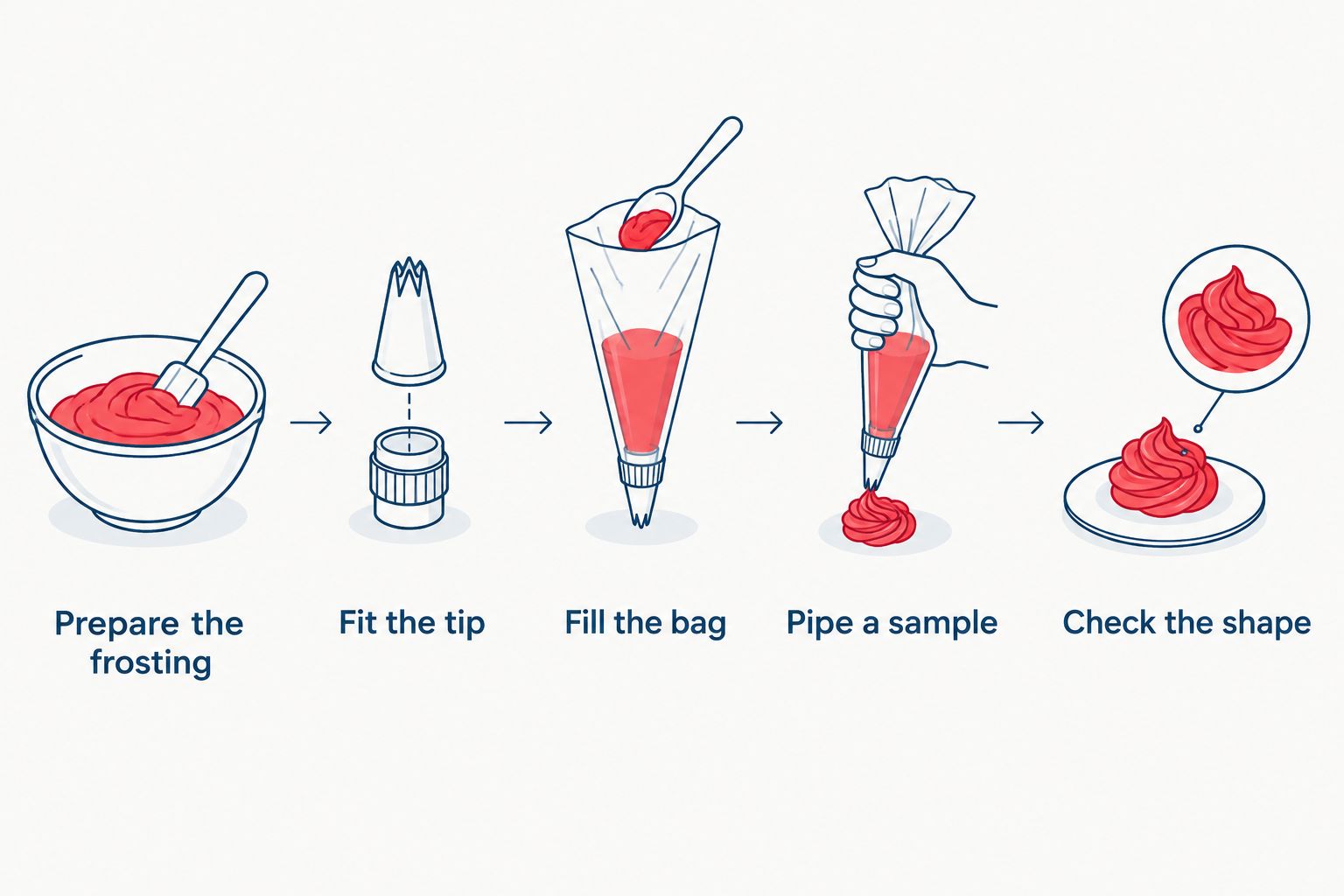
If shells have long tails, check whether you kept squeezing while pulling away. If stars look soft, check the frosting and pause before changing tips. If your hand hurts, do not simply squeeze harder; inspect the opening for a blockage and assess the frosting consistency.
The Buttercream Decorating Notes cover essential buttercream piping and finishing, including swirls, rosettes, and borders. Choose an instructional resource for the technique you are practicing, not just for its title.


Which piping tip set should you choose?
Choose a mixed basic set if you are undecided. It gives you different shapes to learn without committing to a specialist style. Choose a round-and-star pair instead if you want to keep your first project simple.
For flowers, decide whether you want to build petals individually or use a patterned flower opening. For woven cake sides, choose basketweave tips. Those are separate decorating goals, not upgrades every beginner needs.
Your 2026 choice should follow the next cake you plan to decorate. Pick a design, identify its shapes, and select the tips that make those shapes.
FAQ
What are the best piping tips for cake decorating beginners?
Round and star tips are the best starting shapes for beginners. Round tips suit dots and smooth lines; star tips suit textured stars, shells, and rosettes. Choose opening sizes that match your design.
Should I get a large piping tip set or a small one?
Choose a small set when you have a simple first design, and a mixed basic set when you want to learn several techniques. Check the actual shapes included rather than choosing by piece count.
Are open-star tips better than closed-star tips?
Neither shape is better for every decoration. Their openings produce different textures, so compare examples made with the exact tips and choose the result you want.
What piping tip should I use for writing on a cake?
Use a small round tip for fine cake lettering. Practice the words on parchment first and check that the frosting flows without breaking the line.
Do I need a coupler for every piping tip?
No, you can fit a tip directly into a piping bag. A compatible coupler is useful when you want to change tips while keeping the same bag and frosting.
Why does my piped buttercream lose its shape?
Buttercream that is too soft for the decoration will not hold a defined shape. Check its consistency, then practice your pressure and release before assuming the tip is the problem.
Are Russian flower tips easy for a first-time decorator?
Russian flower tips still require control of frosting consistency, pressure, and release. Start with round and star tips if you have not used a piping bag before.
Does Cakedecorationguide sell the piping tip sets in this guide?
Cakedecorationguide sells downloadable cake decorating guides and books, not the physical piping tip sets compared here. Its instructional resources support learning alongside your tools.
One last thing
Your stopping motion is part of the decoration. A dot, shell, or flower can change shape if you keep squeezing while lifting the bag. On your next practice row, focus only on stopping pressure before pulling away.
Keep that single skill on your 2026 practice list. A controlled finish is more useful than another unfamiliar tip.
Related guides