


Best overall: a stable metal cake turntable for regular buttercream decorating. Best for occasional beginners: a basic plastic turntable; best for stationary detail work: a locking turntable; best for angled access: a tilting turntable. This 2026 guide explains which features to check and how to use your choice.
- The best cake turntables for decorating combine smooth rotation, a steady base, and enough room for your cake board.
- Choose a stable metal turntable for regular buttercream smoothing; choose basic plastic for occasional beginner practice.
- Choose a locking turntable for lettering and detail work; choose tilting only when angled access solves a specific problem.
- Cakedecorationguide sells downloadable decorating guides, not the physical turntables compared here.
Why this matters
A cake turntable lets you rotate the cake while keeping your scraper or piping hand in a consistent position. That makes it easier to work around the sides without reaching across your frosting.
It does not correct soft frosting, an uneven cake, or a sliding board. Choose the stand for your decorating task, then practice the movement separately. For step-by-step fundamentals, the Beginner's Cake Decoration Guide from Cakedecorationguide covers frosting smoothing and first simple designs.
Choose stability before extra features. A turntable that moves predictably is more useful than one with attachments you do not need.
What makes the best cake turntables for decorating?
Use these criteria when comparing turntables in 2026. Check the individual model: material alone does not establish how smoothly it turns.
- Smooth rotation: The platform should turn without catching, grinding, or sudden changes in resistance. Test a slow turn, not just a fast spin.
- Base stability: The base should stay put when you apply gentle sideways pressure with a scraper. Check both sliding and rocking.
- Board support: Your cake board needs a secure resting surface. Check the platform dimensions against the boards you actually use.
- Working height: You should be able to see the cake sides and hold your scraper upright without lifting your shoulders.
- Cleaning instructions: Check which parts can be wiped, removed, or washed. Do not assume the bearing assembly can be submerged.
- Useful controls: A lock helps with stationary work; a tilt helps with angled access. Neither is essential for basic smoothing.
Before choosing a turntable, decide whether your next project mainly involves smoothing sides, piping borders, or adding small details. That decision gives the extra features a purpose.
Cake turntables at a glance
These are ranked turntable types, not a comparison of tested branded models. Features such as locks, removable tops, and nonslip surfaces must be checked on the specific product.
| Rank and turntable type | Best for | Standout feature to look for | Key limitation |
|---|---|---|---|
| 1. Stable metal turntable | Regular buttercream smoothing | Steady base and smooth bearing rotation | Metal construction does not guarantee stability or smoothness |
| 2. Basic plastic turntable | Occasional beginner practice | Simple rotating platform with manageable handling | Lightweight designs need particular attention to slipping and rocking |
| 3. Locking turntable | Lettering and stationary detail work | A lock that holds the platform still | Locking does not improve free rotation by itself |
| 4. Tilting turntable | Decorating that needs angled access | Adjustable angle with secure board support | Adds setup checks that basic side smoothing does not require |
1. Stable metal turntable: best for regular buttercream smoothing
A metal turntable with a steady base and smooth rotation is the default choice for repeated side-smoothing practice. You turn the cake with one hand while holding a scraper against the frosting with the other.
Choose the construction carefully. A metal top is not enough: the base, bearing, and board contact all affect how the stand behaves.
Stable metal turntable pros:
- Supports a straightforward smoothing workflow without needing a lock or tilt.
- Lets you inspect the full cake circumference while keeping your scraper position consistent.
- Suits repeated practice with a flat platform and simple rotation.
Stable metal turntable cons:
- Weight, platform size, and rotation quality vary by model.
- Bearing areas can need different cleaning care from the platform itself.
Best for: Home bakers who regularly finish buttercream cakes and want a dedicated smoothing setup.
Before choosing a metal turntable in 2026, check how it behaves under gentle scraper pressure. Look for rocking at the platform edge and movement at the base. A fast free spin tells you less than a controlled slow turn.
Verdict: Buy a stable metal turntable for regular buttercream work, after checking its rotation and base.
2. Basic plastic turntable: best for occasional beginner practice
A basic plastic turntable gives you the essential movement: a flat platform rotates over a base. It is a sensible starting point when you want to learn what turning the cake feels like before choosing extra controls.
Focus on support rather than appearances. A plastic turntable that stays steady is a better practice tool than a decorated stand that rocks.
Basic plastic turntable pros:
- Keeps the setup simple while you learn hand coordination.
- Gives you a rotating surface for crumb coating, side smoothing, and borders.
- Avoids adding tilt or locking controls to your first practice session.
Basic plastic turntable cons:
- Lightweight designs can move when you press against the cake.
- Platform flex and rotation resistance need checking on the individual model.
Best for: Beginners decorating occasionally or learning a basic buttercream finish.
Place the stand on a clean, level work surface. If the base slides, address that before decorating; a nonslip mat beneath the base can help with sliding, but it cannot repair a rocking platform.
Verdict: Buy basic plastic for occasional practice if it passes your stability checks.
3. Locking turntable: best for lettering and stationary detail work
A locking turntable lets you rotate the cake into position, then stop the platform from turning. That is useful when you want to write a message, place a decoration, or pipe a detail without accidental movement.
Release the lock for smoothing. Holding the platform still defeats the main benefit of a turntable when you need to work continuously around the cake.
Locking turntable pros:
- Separates positioning the cake from decorating a fixed area.
- Helps you keep a chosen section facing you during lettering.
- Allows rotating and stationary work on the same stand.
Locking turntable cons:
- The lock must be checked for play and accidental release.
- It adds a control you do not need for ordinary side smoothing.
Best for: Decorators who switch frequently between rotation and small, stationary details.
Check that you can reach the lock without touching the frosting or shifting the base. Engage it, apply gentle turning pressure, and confirm that the platform stays still.
Verdict: Buy a locking turntable when unintended rotation interrupts your detail work; otherwise, skip the extra control.
4. Tilting turntable: best for decorating with angled access
A tilting turntable changes the angle of the cake platform. It gives you another way to approach side details when a flat stand leaves your piping hand or view in an awkward position.
This is a task-specific option, not the default beginner choice. Tilting changes how the board rests, so secure support matters before you start piping.
Tilting turntable pros:
- Changes the working angle without requiring you to lean around the cake.
- Offers another approach to side details and decorative placement.
- Can return to flat work when the model allows that position.
Tilting turntable cons:
- Requires checks for board grip and secure angle adjustment.
- Adds complexity without a clear benefit for basic upright smoothing.
Best for: Decorators who already know which detail requires angled access.
Follow the manufacturer's instructions for securing the cake and setting the angle. Do not improvise an inclined setup with a loose board, especially while learning.
Verdict: Wait on a tilting turntable until you have a specific decorating task that needs it.
How to use a cake turntable without fighting the frosting
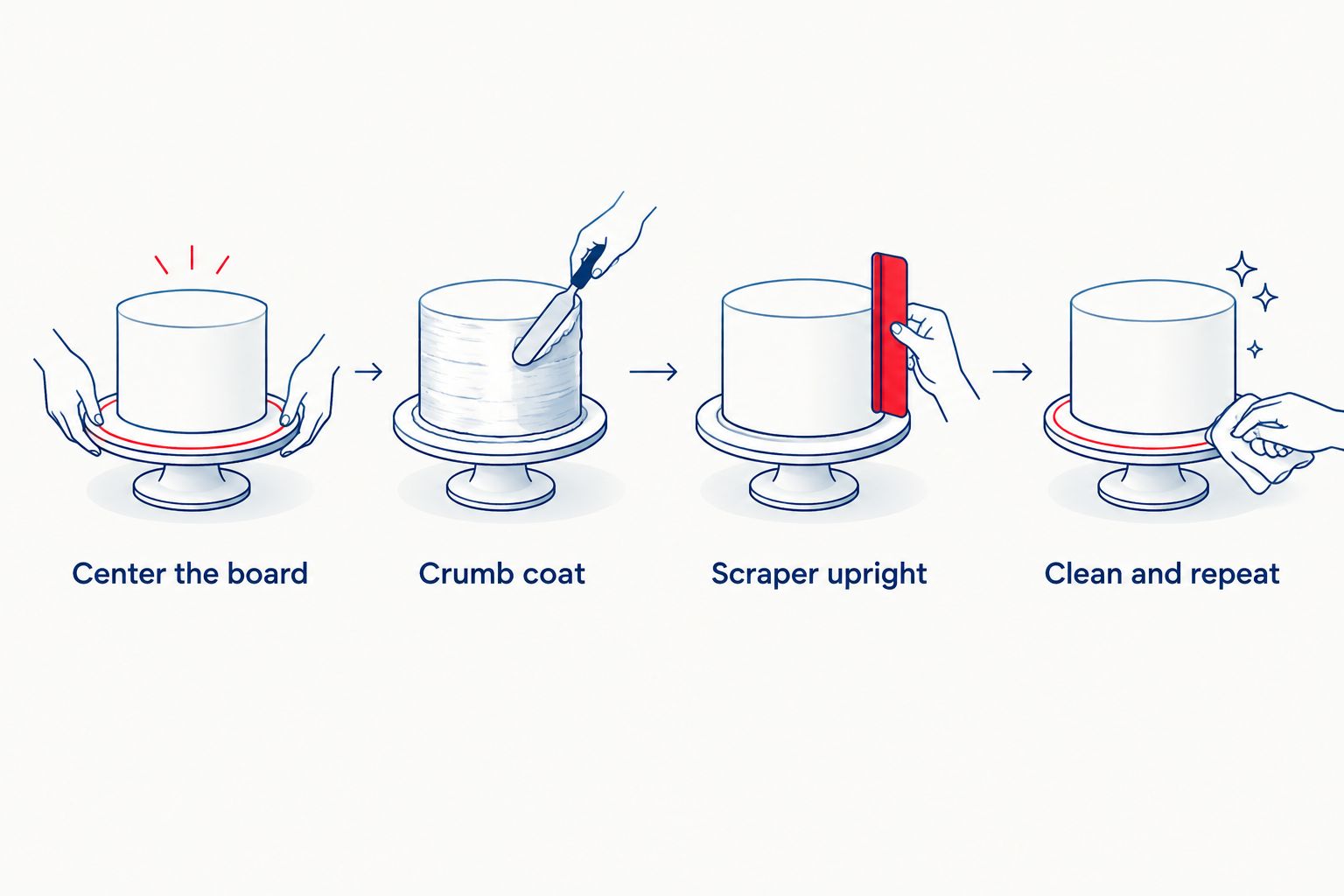
Your first practice session in 2026 should focus on movement, not a complicated design. Start with a level cake on a sturdy board, an offset spatula, and a scraper. An offset spatula has a bent handle that helps keep your hand away from the frosting.
Center the board
Set the board on the platform and turn it through 1 full revolution. Watch its edge: if it travels noticeably from side to side, reposition the board before adding more frosting.
The board should move with the platform rather than slide across it. Keep any gripping material beneath the board, away from the cake and frosting.
Add the crumb coat
Spread a thin first layer of frosting to hold loose crumbs in place. This is the crumb coat; it is not the final smooth finish.
Turn the cake slowly as you spread. Let the coating firm up as appropriate for your frosting before adding the finishing layer.
Hold the scraper upright
Apply the finishing layer, then hold the scraper upright beside the cake. Aim for a 90-degree angle between the scraper and the platform rather than leaning the scraper into the sides.
Use 2 hands for separate jobs: one rotates the stand, and the other steadies the scraper. Keep your pressure light enough that the base stays still.
Clean and repeat
Remove collected frosting from the scraper between passes. Reapplying frosting mixed with crumbs can spoil an otherwise clean surface.
If a hollow spot remains, add frosting there before another pass. Do not keep scraping the surrounding area while expecting an empty patch to fill itself.
Pair the turntable with instructions you will actually use
Cakedecorationguide's downloadable cake decorating guides suit home bakers who want step-by-step fundamentals alongside tool practice. The Beginner's Cake Decoration Guide covers frosting smoothing and first simple designs; Buttercream Decorating Notes covers buttercream piping and finishing, including swirls, rosettes, and borders.
The benefit: You can choose instructions that match the technique you are practicing. The limitation: A digital guide does not supply a turntable, demonstrate your own hand pressure, or correct an unstable setup.
Best for: Beginners who want written instruction to accompany hands-on practice. Choose the fundamentals guide for your starting point or the buttercream notes for a focused piping and finishing topic.


For help deciding which equipment belongs beside your stand, see the Cake Decorating Tools Guide. Add tools to solve a task, not simply to fill a kit.
How these turntable types are ranked
This 2026 ranking prioritizes the beginner tasks described above: controlled rotation, a steady base, board support, and straightforward use. Metal takes the default slot only when the actual stand meets those criteria; plastic remains a reasonable choice for occasional practice.
Locking and tilting designs earn separate places because they solve different access problems. Neither feature makes a turntable automatically better for smoothing.
Which cake turntable should you choose?
Choose a stable metal turntable for regular buttercream decorating. If you decorate occasionally, start with a basic plastic model that stays steady under light pressure.
Choose a lock when you need the cake to remain still for detail work. Leave tilt until you can name the task it will help you complete. For your 2026 setup, a controlled turn and secure board matter more than a long feature list.
FAQ
What's the best cake turntable for a beginner?
A basic, stable turntable with smooth rotation is the best starting point for a beginner. Choose plastic for occasional practice or a stable metal model for regular buttercream work; check the actual stand rather than relying on material alone.
Is a metal cake turntable better than plastic?
Metal is not automatically better than plastic. A steady base, smooth rotation, and secure board support matter more than the platform material, though a stable metal stand is the default recommendation for regular smoothing.
Do I need a locking cake turntable?
You need a lock only when keeping the cake stationary helps your task. Lettering and small details can benefit from a fixed platform; side smoothing needs free rotation.
Is a tilting cake turntable good for beginners?
A tilting turntable is not the default beginner choice. Start flat for basic smoothing, then consider tilt when a specific detail needs angled access and you can secure the board according to the manufacturer's instructions.
Why does my cake board slide on the turntable?
The board slides when it does not grip the platform securely. Check that the contact surfaces are clean and use suitable gripping material beneath the board; stop decorating if the board still moves independently.
Can I decorate a cake without a turntable?
Yes, you can decorate a cake without a turntable. A stationary board works for simple spatula finishes and top decorations, but you must reposition the cake or yourself to reach different sides.
Can I wash a cake turntable in the dishwasher?
Use a dishwasher only if the manufacturer's instructions explicitly allow it. The platform, base, and bearing assembly can have different cleaning requirements, so do not assume the whole stand is washable.
One last thing
Before replacing your turntable, check whether the base is moving or the cake board is sliding. Those are different problems. Stabilizing the base will not secure a loose board, and gripping the board will not repair a rocking platform.